Βιβλιοθήκη Φραγκίσκος – Biblioteca Francesco seeks to encourage reading and music as therapy, through the library and podcasts made by experts in different fields. The Bibliothíki also aims to raise awareness on societal noise, hearing conditions, and their effects on mental health, through small publications, online and offline events.
If you live with hyperacusis, misophonia and/or chronic tinnitus, and would like to share your story or contribute in any way to our awareness raising activities, please get in touch (bibliofrancesco at gmail).
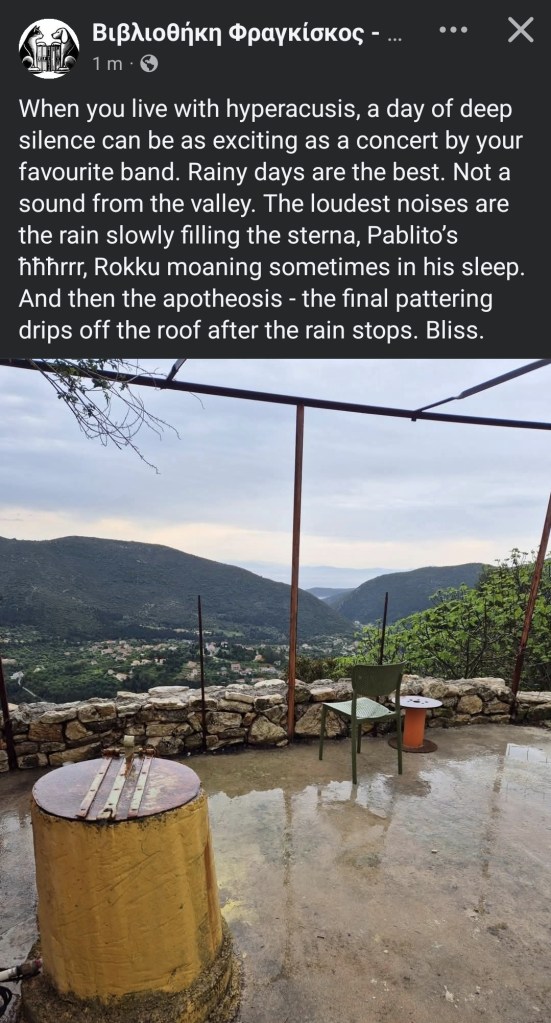
Much has been written about tinnitus and misophonia, yet research on hyperacusis is still at early stages. Each of these conditions is invisible, and more difficult to live with as civilisation becomes progressively louder – and less respectful. Phone speakers in waiting rooms (bad for everyone’s ears), chairs dragged not lifted in cafés, drivers leaving their engine running as they run an errand… not to mention motorbikes with modified exhaust pipes, or yachts broadcasting strident bumm-bumm musica del sistema in secluded bays…
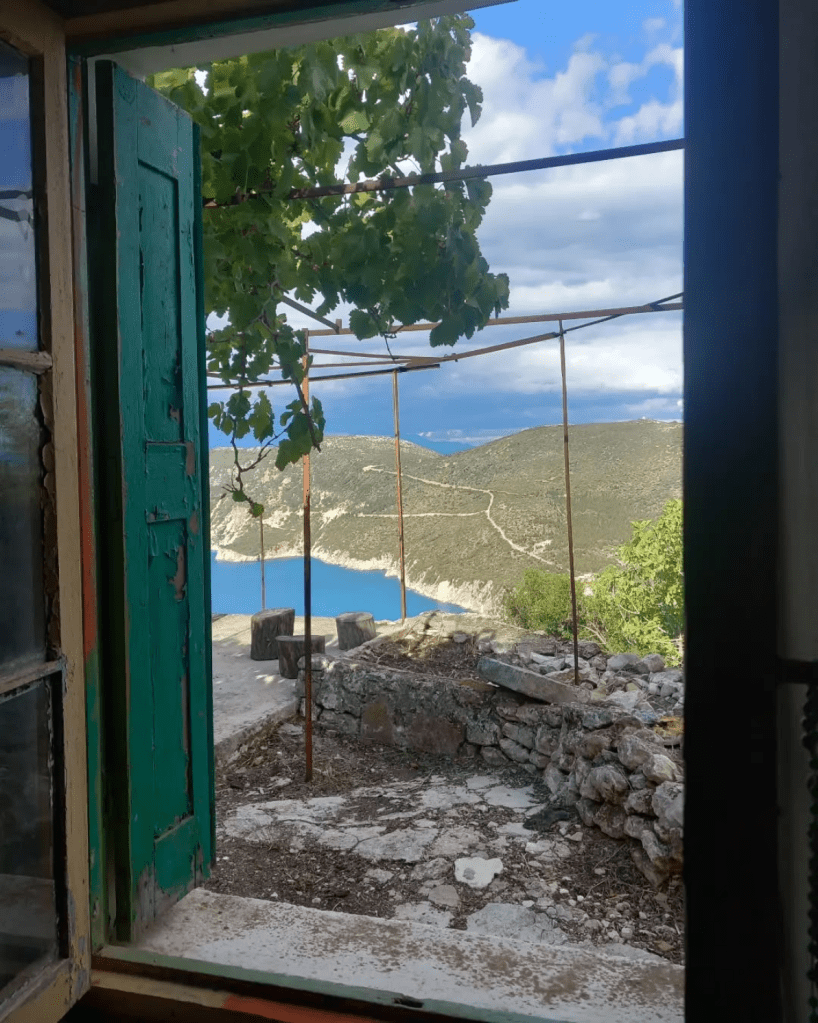
This is why I live in a library house, on a mountain path above the Ionian sea. To my ears, everything – particularly plastic, mechanical and electrical sounds – is five, ten, twenty times louder. My own village, Qrendi, in what used to be rural Malta, became too loud, mostly due to never-ending construction, six floors at a time.
How rare is hyperacusis? Until recently, apart from people I have conversed with on internet discussion groups, the only other person I knew with this condition was my grandfather (Nannu Frank), before it even had a medical name. Since I moved from Malta to Greece, I have accidentally met two people with hyperacusis, in Samos and in Astakós. The first used to be a schoolteacher, but was forced to stop as he became incapable of handling more than two voices at once.
We are not that rare, and we are certainly not crazy. If you see us suddenly covering our ears and crumpling our face, we are not exaggerating. The pain is physical, and can affect the whole nervous system. The eardrum ache can last for weeks. (I tend to ‘forget’ it only when I’m reading.) It is very difficult to remain calm when assailed by noise. And even more difficult to avoid becoming a social outcast, because there are many places we would rather not go to, for the sake of our ears and especially our mental health.
As I discussed with my new friend in Astakós, hyperacusis can also be a superpower – we hear tiny things that most people don’t. Since my condition surfaced during the first covid lockdown, my appreciation and understanding of music (pitch, intervals etc.) drastically improved. In one song by the Rolling Stones, I can even hear a piece of paper being shifted on a desk or atop the piano. Perhaps we should call our condition ‘superacusis’ instead. On the other hand, as we know well, all superpowers entail the solitude of never being understood.
I wear headphones whenever I have to venture into society – shopping, bureaucracy etc. -, with a blue deaf sticker on each side so people don’t think I’m rude when I keep them on during a conversation. (In any case, hyperacusis is a form of deafness, and often leads to total deafness with age, as was the case of Nannu Frank.) I wear these stickers with pride, and also have them on the bibliojeep, notebooks etc. Better to own it than try to pretend that I am ‘normal’.

My last noise-induced panic attacks (a burglar alarm and an embassy doorbell) were in Istanbul, where I went for a poetry festival. A week later, I was adopted by Rokku, my deaf-mute dog from Samos. He keeps me calm, in the bibliojeep (no road rage), in town, even during a recent walk through Athens. I sometimes wish I was deaf like him. Then again, I still have plenty of music to enjoy and compose, and if I do eventually go deaf, I would like to have mastered music sheet reading first, so I’ll be able to hear it in my head.
There are not many documentaries on hyperacusis out there. This one, produced by Stichting Hoormij nearly ten years ago, is very good. In Dutch, with English subtitles.
